Helping global brands access data on human rights and labor risks in their supply chain
Global supply chains are complex and lack transparency, causing human rights and labor risks to persist without notice by companies who have a responsibility to prevent them. We designed a worker survey tool and interactive dashboard that collects and visualizes risk data to help companies become aware of risks in their supply chains and guide corrective action.
Scope
New product development
Role
Product designer
Company
Ulula
Timeline
2023-2024
The problem
Supply chain complexity hides labor risks
Global supply chains are fragmented, offshore, and often subcontracted, leaving brands with limited visibility into labor and human rights conditions. As new legislation mandates public disclosure of supply chain risks, companies must prove they can identify and remediate issues, yet most lack reliable, ground-level data.
Our solution
Surfacing insights about working conditions on the ground
We designed a technology-enabled system that gathers trustworthy worker feedback across languages, devices, and literacy levels, and transforms it into credible, report-ready insights. The system has two core components:
Mobile app
Worker-centered data collection
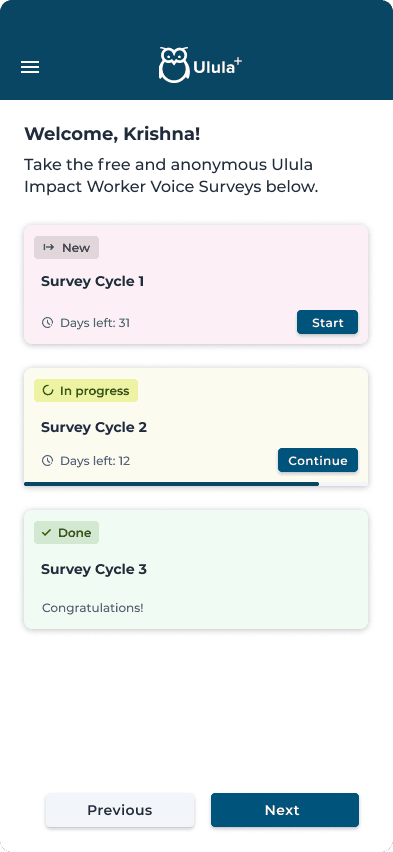
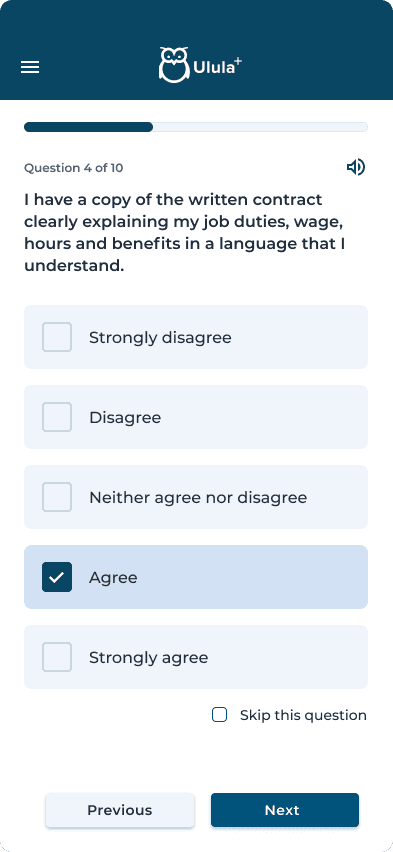
We designed a mobile survey experience that enables workers to safely report on working conditions, wages, hours, safety, and management practices using their own devices.
Target user: ground-level workers
Web dashboard
Real-time risk visualization
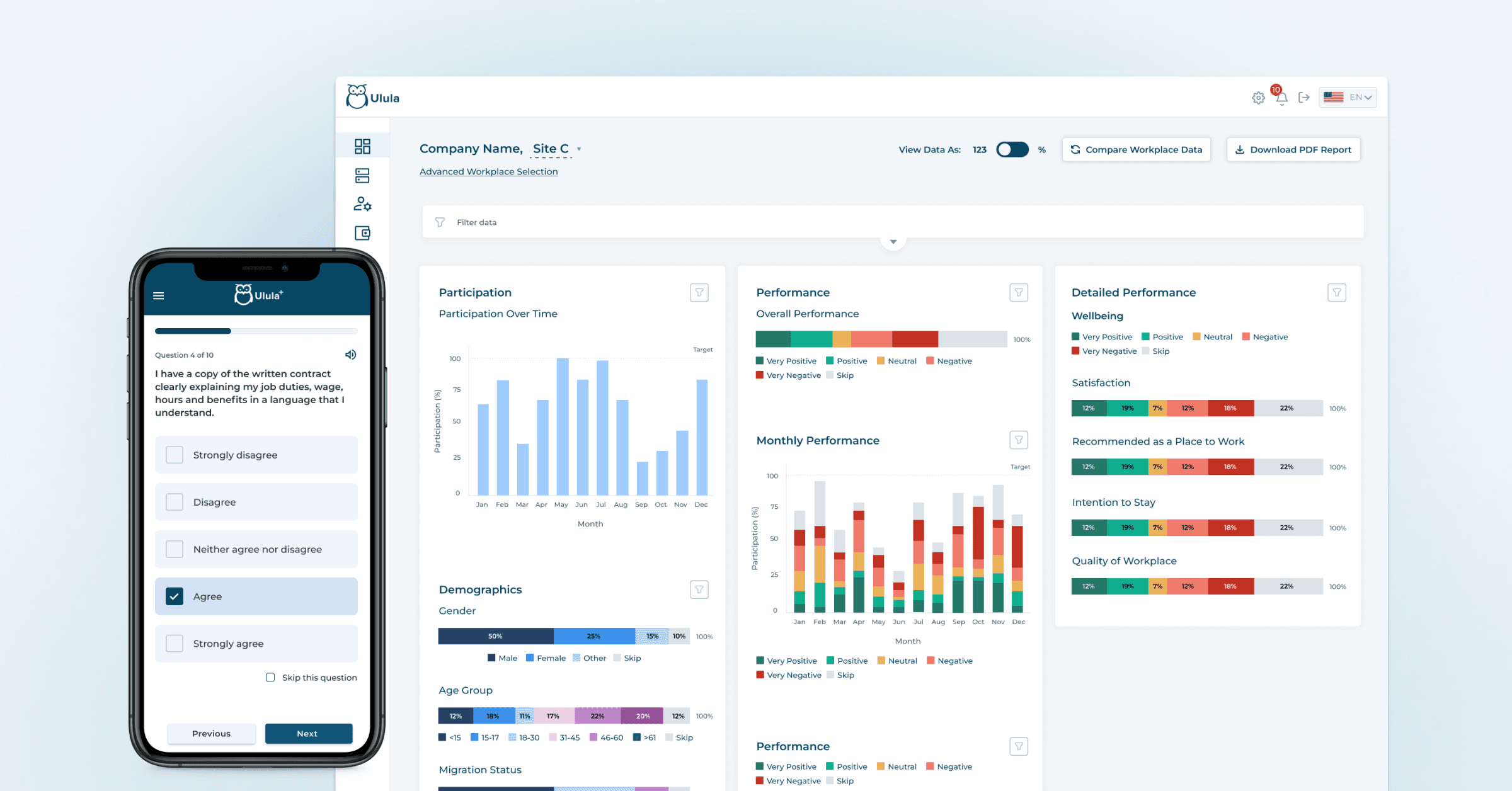
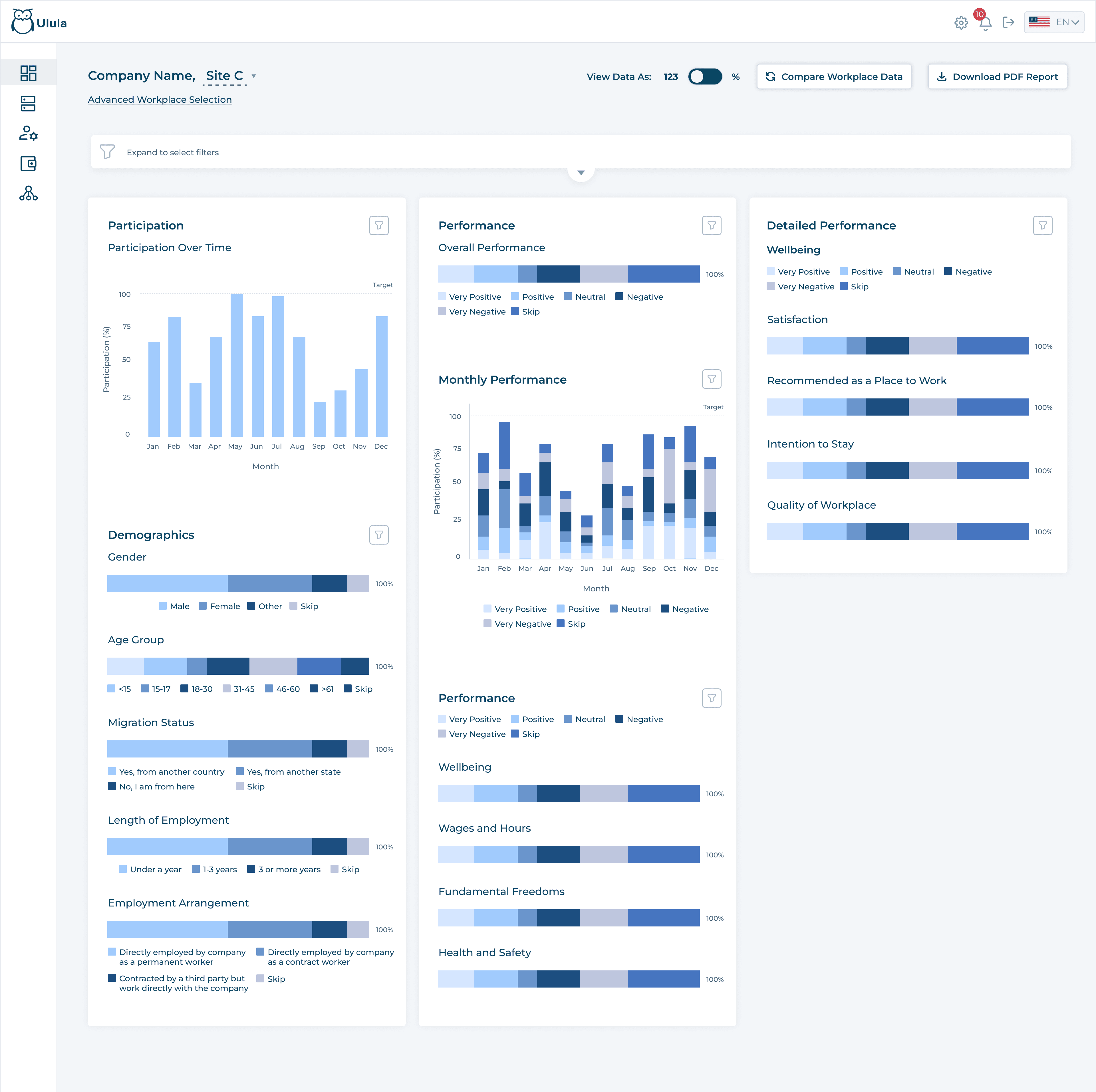
We designed a live dashboard that translates raw survey responses into clear, actionable insights for global brands. The dashboard highlights emerging labor and human rights risks, severity and frequency of reported issues, geographic and supplier-level patterns, areas requiring corrective action. By structuring and visualizing worker-reported data, the platform enables brands to prioritize interventions, meet regulatory reporting requirements, and move from reactive audits to continuous visibility.
Target user: global brands
Worker-centered data collection
Our starting point was a rigorously developed survey methodology, shaped by years of field research and interviews with supply chain workers. Social scientists on our team had refined the question framing to ensure clarity, cultural sensitivity, and accuracy. The design challenge was translating this research-backed methodology into a mobile experience that workers would trust, complete, and return to. We grounded the interface in three core design goals:
Build trust
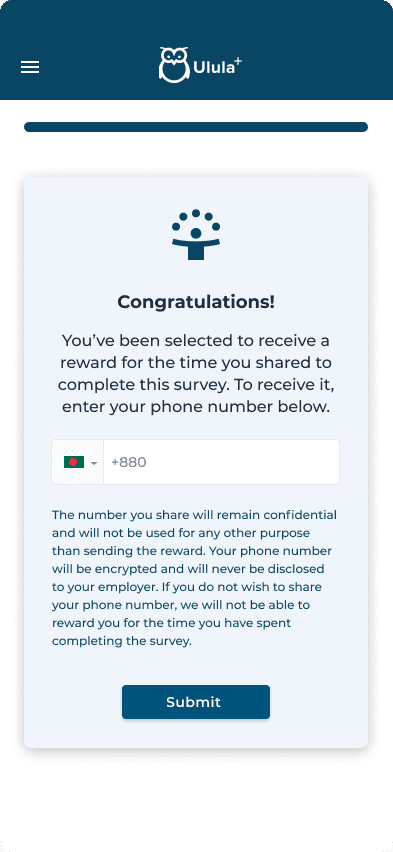
Workers needed to feel safe sharing honest feedback, particularly in environments where retaliation is a real risk. To reinforce safety and credibility, we clearly communicated anonymity and data protection at key moments in the journey, used plain, localized language to avoid ambiguity and reduced unnecessary data collection to minimize perceived risk.
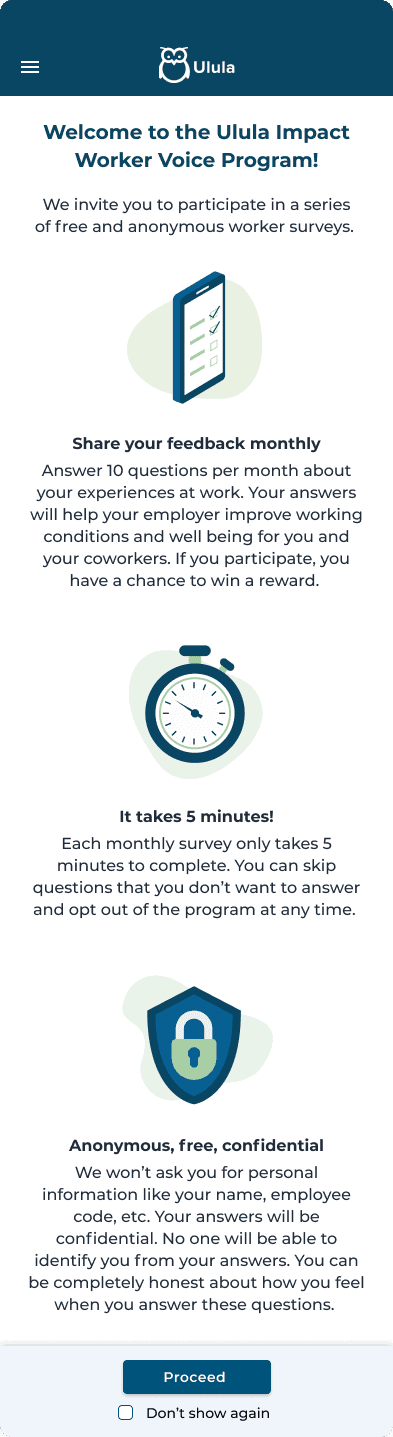
Encourage participation
Completion rates directly impact data quality. The experience needed to feel lightweight, validating, and easy to navigate. We designed for momentum and clarity by breaking long surveys into digestible steps, using visible progress indicators to reinforce completion, providing clear confirmation states, designing touch targets large enough to prevent mis-clicks and allowing users to pause and return without losing progress.
Accessible and inclusive by default
Workers across global supply chains vary in language, literacy, device access, and technical familiarity. To reduce barriers, we supported multiple languages, used simple sentence structures and plain-language copy, ensured high contrast and legible typography and minimized text-heavy screens where possible.
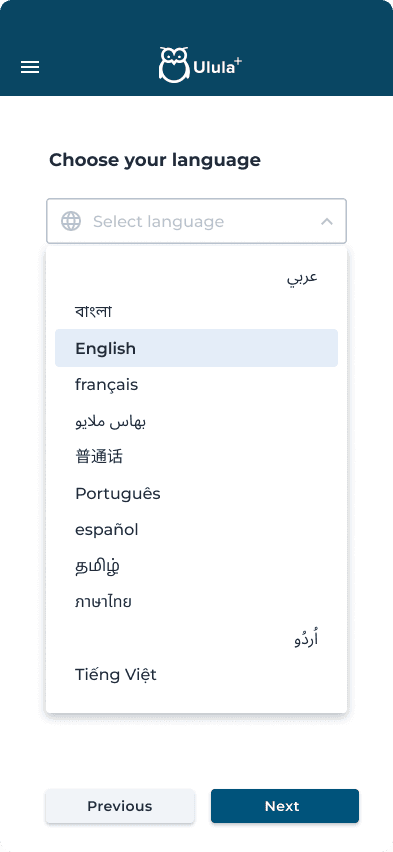
Language selection screens enables users to experience the app in their native language.
Each survey question is accompanied by an audio recording in the user's selected language to support copmrehension among users who have lower literacy levels.
Real-time risk visualization
Collecting worker feedback was only half the solution. The second challenge was transforming raw survey responses into structured, credible insight that brands could interpret, act on, and report against. We designed an interactive dashboard grounded in three principles:
Make risk interpretable
Users (global brands, buyers, and suppliers) needed an immediate understanding of overall performance without getting lost in raw data. To support clarity at a glance, we surfaced high-level risk indicators and summary metrics, used visual hierarchy to distinguish severity levels, grouped issues by theme (wages, safety, working hours, etc.) and highlighted trends and outliers.
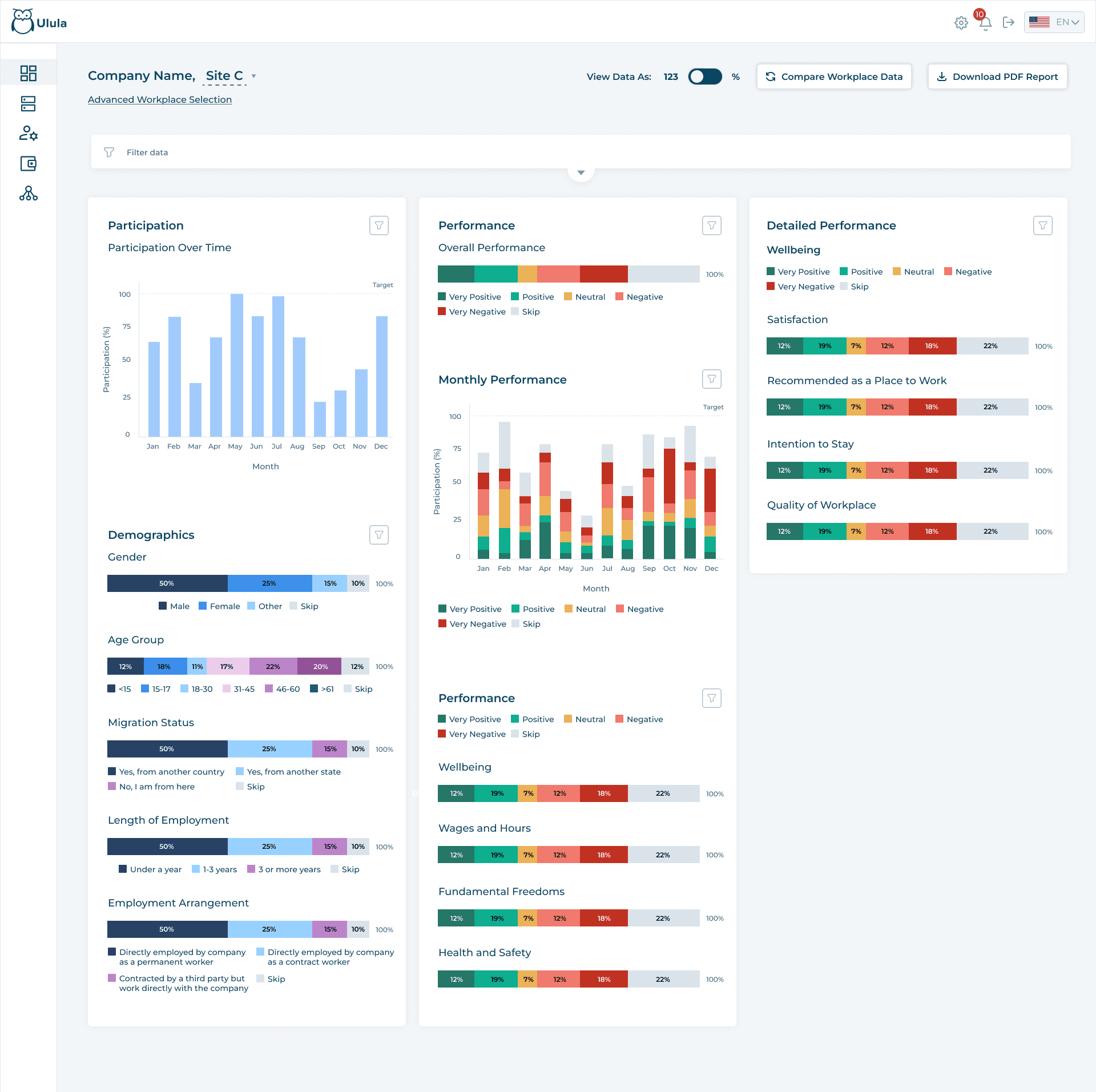
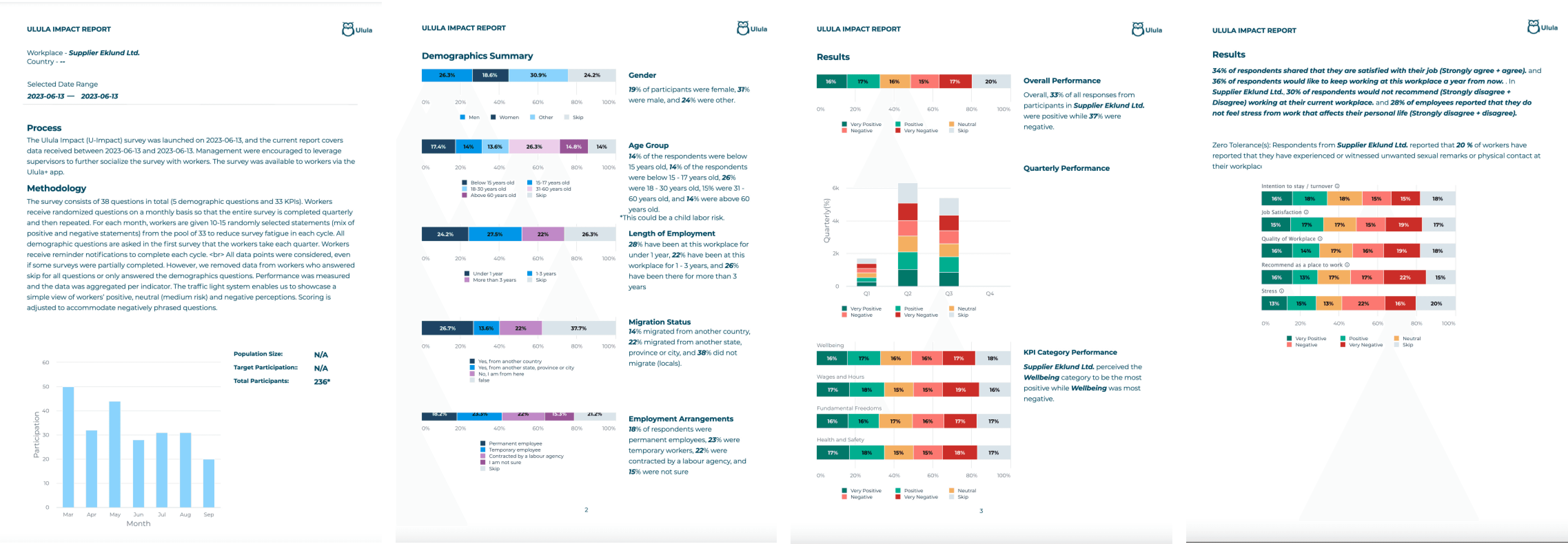
Applying a traffic light system colour scheme to signal risk. The color scheme enhances data readability, offering a quick visual indication of its significance: red and orange for higher risk, yellow for moderate risk, and shades of green for positive values like performance improvements.
Enable exploration
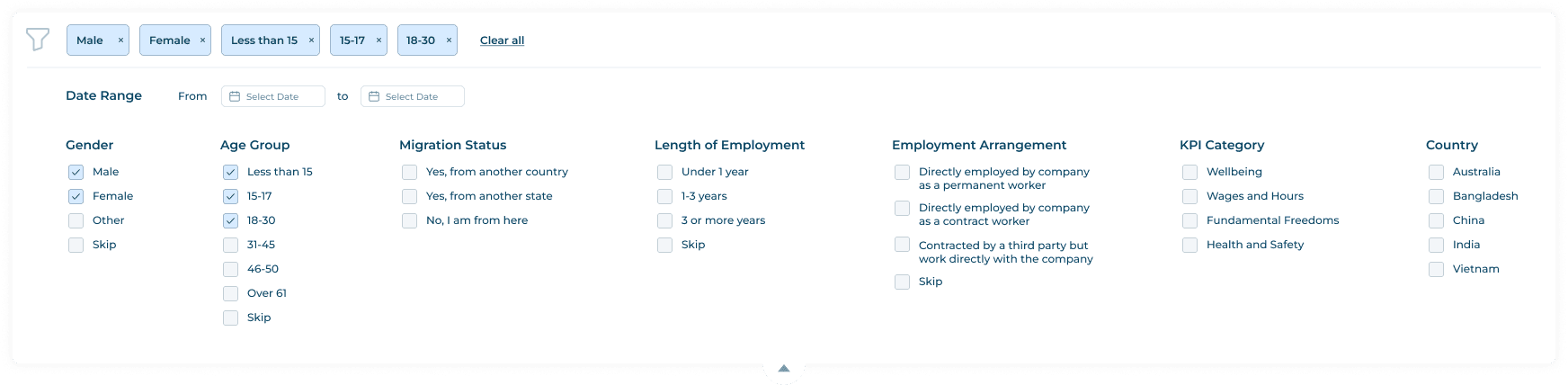
While executives needed summaries, compliance and sustainability teams required deeper investigation capabilities. We designed the dashboard to allow filtering by geography, supplier, and time period, enable drill-down into specific issue categories, provide contextual metadata alongside metrics, maintain consistency between summary views and detailed views and support comparisons across segments. This allows users to move seamlessly from high-level insight to root-cause analysis.


Make insights operational
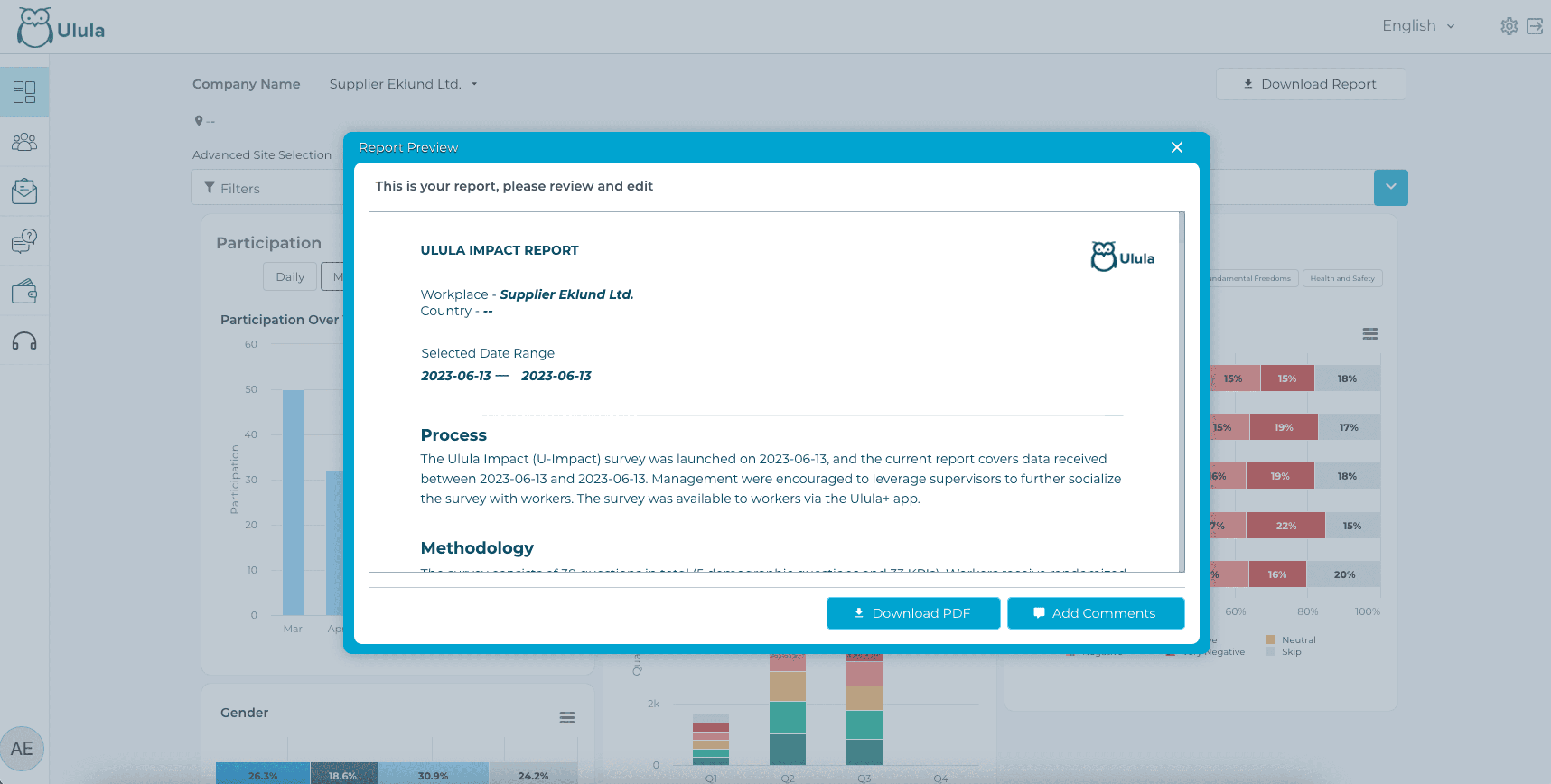
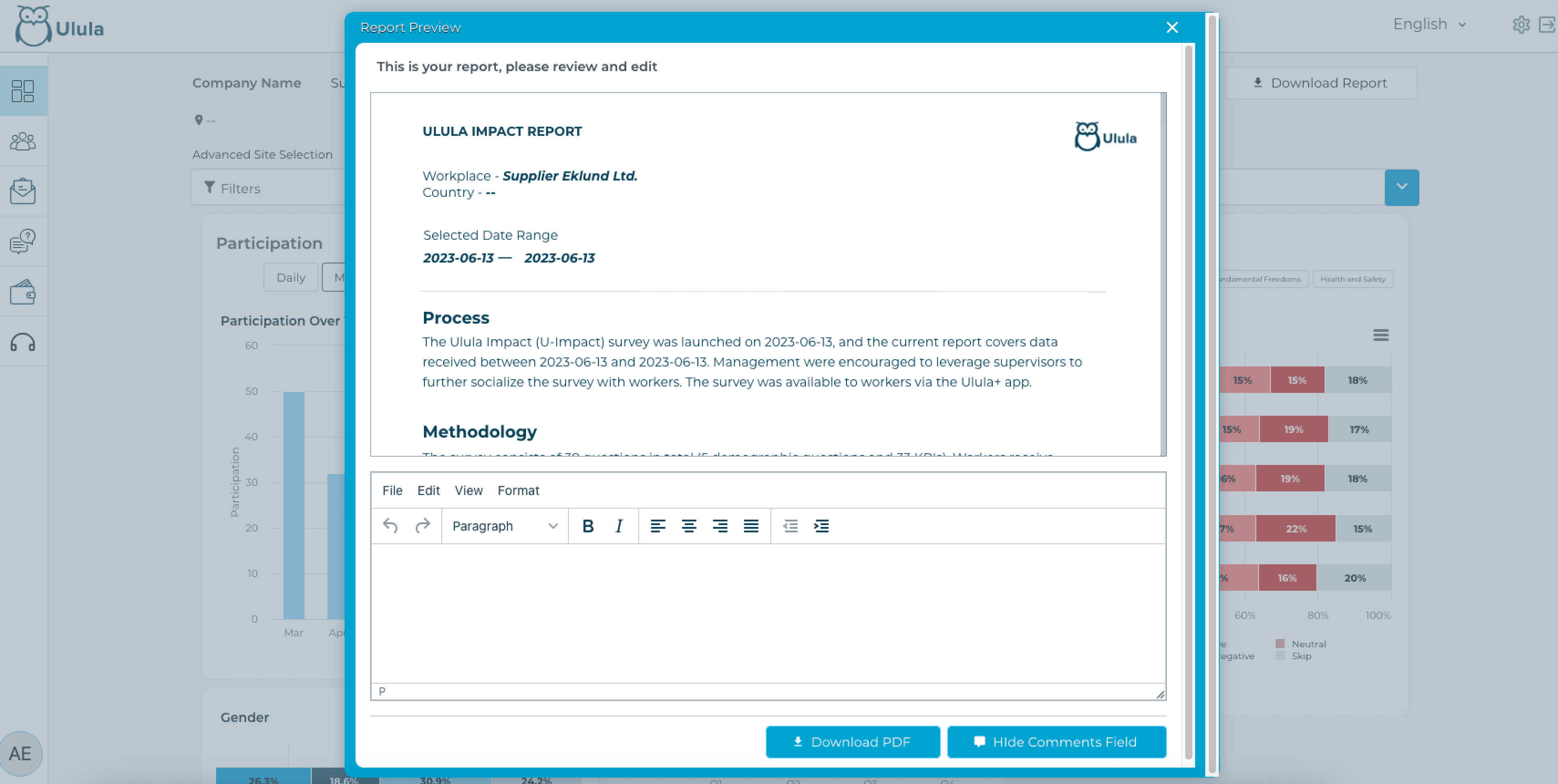
Data needed to extend beyond the dashboard into board decks, annual reports, and strategic planning discussions. To ensure usability beyond the interface, we enabled exportable reports and downloadable data formats, structured insights in language aligned with regulatory reporting requirements, designed charts and summaries that could be directly embedded into corporate reporting, and ensured consistency between visual outputs and underlying methodology. The result was not just a visualization tool, but a reporting-ready intelligence system.
Impact and outcomes
Validated Improvements
We conducted two rounds of usability testing with 10 participants, including 6 client representatives and 4 worker engagement specialists. Following the first round of testing, we implemented structural and copy refinements across both the mobile app and dashboard. Through iterative testing, we reduced ambiguity in survey language, improved navigation clarity across complex data views, increased perceived credibility of analytics outputs, and strengthened alignment between worker experience and brand-facing insights. By launch, the platform was more intuitive, accessible, and decision-ready.
Usability issues decreased by 40%
Task completion rates improved
Participants reported greater clarity and confidence navigating the interface
Success metrics defined for launch
Although I transitioned from the company prior to public launch, we defined the following metrics to evaluate long-term impact. Defining these metrics ensured the product’s success could be measured not only by usability, but by adoption, operational efficiency, and regulatory impact.
Adoption & Growth
Conversion rates among budget-conscious brands
Partner referrals through supplier network invitations
Expansion of active supplier participation
Engagement
Survey completion and re-engagement rates
Dashboard session depth and filter usage
Frequency of report exports
Impact & Efficiency
Increase in accessible labor risk data coverage
Reduction in manual program development costs through automation
Time saved generating compliance-ready reports
Reflections
This project reinforced that designing in complex, high-stakes systems requires bridging two very different realities:
Workers need safety, clarity, and accessibility.
Brands need structured, defensible, decision-ready insight.
Designing both ends of that system and ensuring trust flows through it shaped how I approach product design today.